Enhanced Q&A Chatbot with Groq & LangChain
Fast AI-powered conversational assistant with multiple LLM options and real-time adjustable parameters
Project Overview
An enhanced Q&A chatbot built with Streamlit that leverages Groq's ultra-fast inference API and LangChain's powerful orchestration framework. The application provides an intuitive interface for users to interact with multiple state-of-the-art language models with adjustable parameters for customized responses.
Challenge
Traditional chatbot interfaces often lack flexibility in model selection and parameter tuning. Users need a simple yet powerful interface that allows them to experiment with different LLMs and adjust response characteristics (temperature, max tokens) in real-time without diving into code.
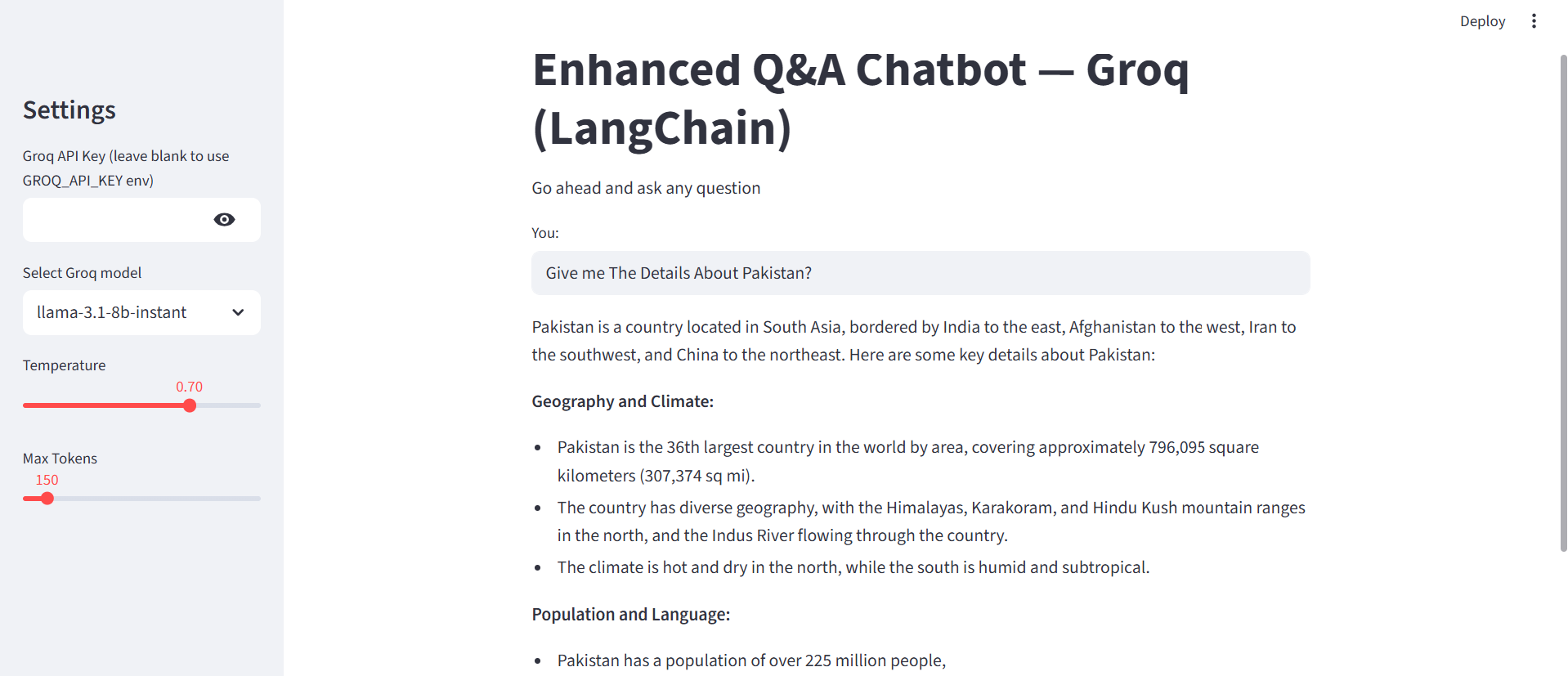
Live Streamlit interface showing the chatbot answering "Give me The Details About Pakistan?" with adjustable parameters (Temperature: 0.70, Max Tokens: 150) using Llama 3.1 8B Instant model via Groq API.
Technical Approach
Architecture & Framework Selection
Designed a modular architecture using LangChain for LLM orchestration and Streamlit for rapid prototyping of the user interface. Integrated Groq API for ultra-fast inference speeds.
- Streamlit: Interactive web interface with real-time updates
- LangChain: Prompt engineering and LLM chain orchestration
- Groq API: Sub-2-second inference for multiple open-source models
- LangSmith: Tracing and monitoring for production debugging
Prompt Engineering & Chain Design
Implemented a structured prompt template using LangChain's ChatPromptTemplate with system and human message roles for consistent behavior across different models.
from langchain_core.prompts import ChatPromptTemplate

prompt = ChatPromptTemplate.from_messages([
    ("system", "You are a helpful assistant. Please respond to the user queries."),
    ("human", "{question}"),
])

# Chain: Prompt → LLM → Parser
chain = prompt | llm | output_parser
answer = chain.invoke({"question": question})Multi-Model Integration
Integrated four different LLM models accessible through Groq's API, each with unique characteristics for different use cases.
- Llama 3.1 8B Instant: Fast, balanced performance for general queries
- GPT-OSS 120B: Larger model for complex reasoning tasks
- Qwen3 32B: Multilingual capabilities and instruction following
- Gemma2 9B-IT: Instruction-tuned for high accuracy
UI/UX & Parameter Controls
Built an intuitive Streamlit interface with sidebar controls for model selection and hyperparameter tuning. Implemented secure API key handling with environment variable fallback.
- Model selector dropdown with 4 options
- Temperature slider (0.0 - 1.0) for creativity control
- Max tokens slider (50 - 1024) for response length
- Secure API key input with password masking
- Real-time response generation with loading spinner
Technical Stack
Framework
- Streamlit 1.50.0
- Python 3.10+
LLM Orchestration
- LangChain 0.3.27
- LangChain-Groq 0.3.8
- LangSmith (tracing)
APIs & Services
- Groq API (inference)
- LangChain API
Environment
- python-dotenv
- Virtual environment
Key Features
🚀 Ultra-Fast Inference
Leverages Groq's optimized inference engine for sub-2-second response times, significantly faster than traditional cloud LLM APIs.
🎛️ Dynamic Parameter Tuning
Real-time adjustment of temperature and max tokens without restarting the application, allowing users to fine-tune response creativity and length on-the-fly.
🤖 Multi-Model Support
Switch between 4 different LLMs seamlessly, each optimized for different tasks: speed, reasoning, multilingual support, or instruction following.
🔍 LangSmith Tracing
Built-in observability with LangSmith for debugging chain execution, monitoring latency, and analyzing model performance in production.
🔐 Secure API Management
Supports both environment variable and UI-based API key input with secure password masking, enabling flexible deployment options.
💬 Clean Conversational UI
Intuitive Streamlit interface with clear input/output separation, loading indicators, and helpful prompts for better user experience.
Results & Impact
⚡ Performance
- Sub-2-second average response time
- Real-time parameter adjustment
- Zero cold-start delays with Groq
- Efficient token usage monitoring
🎯 Functionality
- 4 production-ready LLM models
- Accurate, contextual responses
- Customizable system prompts
- Extensible chain architecture
📈 Developer Experience
- Simple 3-file project structure
- Easy local deployment (one command)
- Clear separation of concerns
- Production-ready with tracing
Lessons Learned
Key Insights
- Groq's Speed Advantage: Groq's inference speed (sub-2s) is significantly faster than standard cloud APIs, making real-time chat experiences viable even with larger models.
- LangChain Abstraction: LangChain's chain abstraction simplifies swapping between different LLM providers without rewriting application logic.
- Parameter Sensitivity: Temperature and max tokens have dramatic effects on response quality—exposing these controls to users increases flexibility but requires good defaults.
- Observability Matters: LangSmith tracing is invaluable for debugging prompt issues and understanding model behavior in production.
- Streamlit Limitations: While great for prototyping, Streamlit's stateful session management can be tricky for complex conversation history—consider alternatives for production chat applications.
Interested in Building GenAI Applications?
I can help you build production-ready chatbots, RAG systems, and LLM-powered applications tailored to your business needs.